
The molecule that holds the lights on.
Every waking moment is underwritten by a few tens of thousands of neurons in your hypothalamus, secreting a peptide pair called orexin. Lose them and the boundary between waking and sleep collapses — that is narcolepsy type 1. Block their receptors and you get a sleeping pill. Agonise them — the frontier medicine is crossing right now — and you get something neurology has wanted for a century: a way to give the wakefulness signal back.
What orexin is
In 1998, two laboratories on opposite sides of America announced the same hypothalamic peptides within weeks of each other — one group called them hypocretins, the other orexins. Both names stuck, and the double naming is itself a small monument to independent discovery.
Two peptides
Orexin-A and orexin-B (hypocretin-1 and -2) are cut from one precursor, prepro-orexin. Luis de Lecea's group found them hunting for hypothalamus-specific messengers (PNAS, Jan 1998); Takeshi Sakurai and Masashi Yanagisawa's team found them as ligands of two orphan receptors (Cell, Feb 1998).
Two receptors
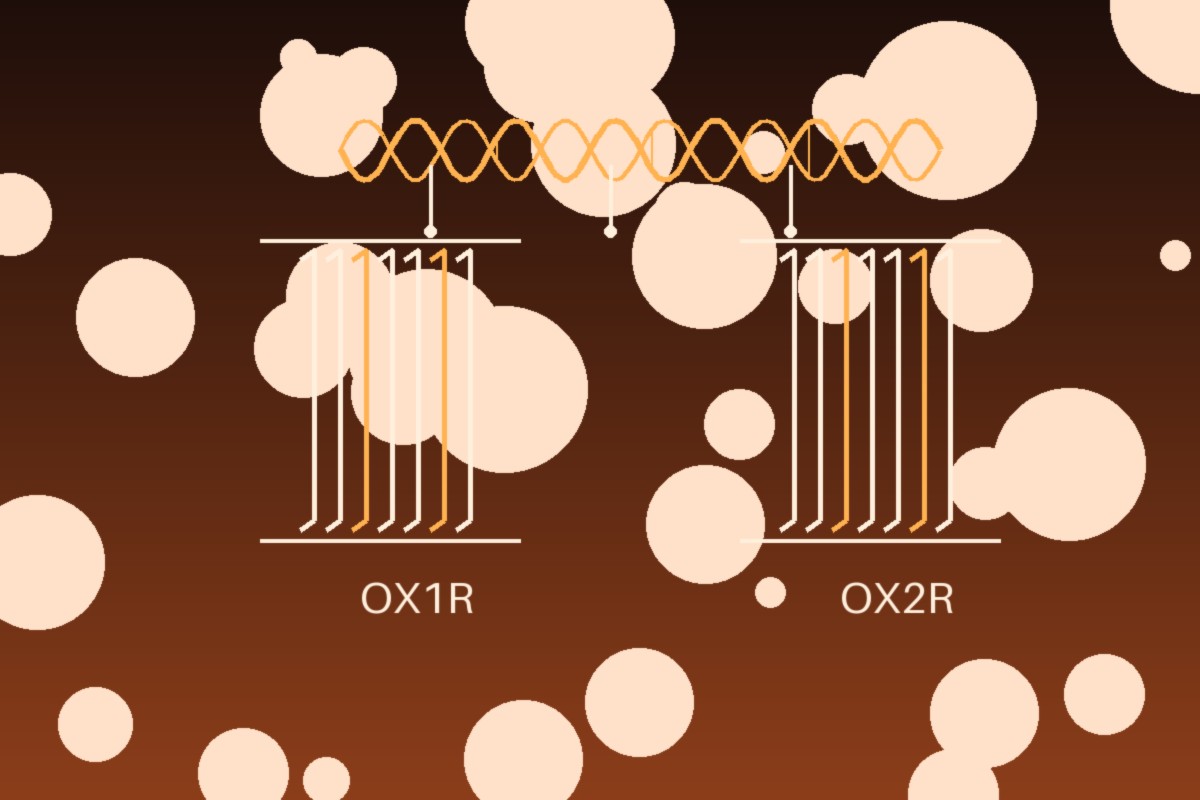
OX1R prefers orexin-A; OX2R binds both peptides. The receptors sit on arousal centres across the brainstem, thalamus and cortex — the locus coeruleus leans on OX1R, the histamine neurons of the tuberomammillary nucleus lean on OX2R (review, Br. J. Pharmacol. 2014).
One tiny nucleus
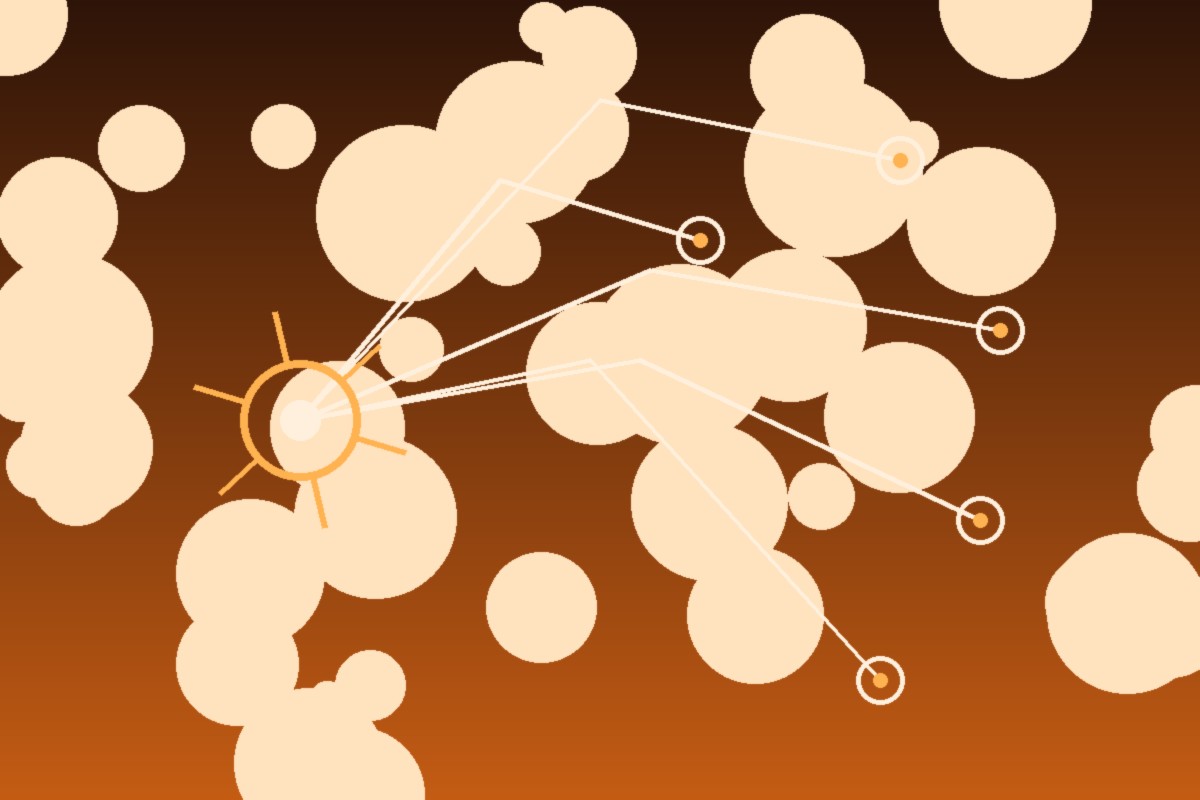
In humans the entire orexin system is roughly 50,000–80,000 neurons in the lateral hypothalamus — yet their axons fan out to nearly every arousal centre in the brain. Wakefulness has a single small command post.
The stabiliser, not the starter
Orexin does not so much switch the brain on as keep it on: it stabilises the waking state and holds sleep at bay. Without it, the brain flickers between states it can no longer hold apart.
When the signal vanishes: narcolepsy type 1
Within two years of its discovery, orexin went from curiosity to the cause of a disease that had puzzled medicine since the 1880s.
1999 — the animal proof
- Emmanuel Mignot's Stanford team shows that inherited canine narcolepsy is caused by mutations in the OX2R (hypocretin receptor 2) gene (Lin et al., Cell 1999).
- Masashi Yanagisawa's group reports that mice lacking orexin itself develop narcolepsy with cataplexy (Chemelli et al., Cell 1999).
2000 — the human confirmation
- Two teams — Peyron et al. (Nature Medicine 2000) and Thannickal et al. (Neuron 2000) — examine human narcolepsy brains and find the orexin neurons simply gone: an 85–95% selective loss.
- Nishino et al. show orexin-A is undetectable in the spinal fluid of most patients (Lancet 2000) — the diagnostic signature of narcolepsy type 1.
Blocking orexin: the sleep medicines
If orexin holds the brain awake, an orexin antagonist is a switch for sleep itself — not a sedative fog, but a targeted release of the wakefulness grip. Three such dual orexin receptor antagonists (DORAs) reached the pharmacy:
Suvorexant — 2014
Merck's Belsomra, the first orexin receptor antagonist approved anywhere (FDA, August 2014). It blocks OX1R and OX2R to let sleep arrive.
Lemborexant — 2019
Eisai's Dayvigo (FDA, December 2019), a dual antagonist developed from Eisai's orexin chemistry programme.
Daridorexant — 2022
Idorsia's Quviviq (FDA, January 2022). Its phase 3 programme showed improved night-time sleep and daytime functioning in insomnia (Mignot et al., Lancet Neurology 2022).
The elegant inversion
The same two receptors, pushed in opposite directions: antagonists to invite sleep where it will not come, agonists to restore wake where it cannot stay. Few systems in pharmacology are this legible.
The agonist frontier: giving the signal back
Narcolepsy type 1 is a hormone-deficiency disease of the brain: the patients are missing the peptide itself. The direct answer — replace the signal with an orexin receptor agonist — took two decades of chemistry, and it is arriving now.
The road so far
- TAK-925 (danavorexton) — Takeda's intravenous OX2R agonist — established human proof of concept: a single infusion reversed sleepiness in narcolepsy type 1 patients (Evans et al., PNAS 2022).
- TAK-994, the first oral candidate, improved wakefulness in phase 2 but was halted in October 2021 after a liver-safety signal (Takeda, 2021; Dauvilliers et al., NEJM 2023) — a hard lesson the field absorbed and moved past.
Oveporexton (TAK-861)
- Takeda's oral, OX2R-selective agonist. Phase 2 in narcolepsy type 1: dose-dependent improvement in wakefulness and cataplexy (Dauvilliers et al., NEJM 2025).
- Phase 3 FirstLight and RadiantLight programmes reported positive topline results in 2025, presented at World Sleep 2025 (Takeda, Sept 2025).
- February 2026: the FDA accepted the oveporexton new drug application with priority review, with a decision expected in the third quarter of 2026 (Takeda, Feb 2026) — potentially the first medicine to address the root cause of narcolepsy type 1.
Panacea's research position
At Panacea Bio Chem, Bogdan Dicoias works in amino acid chain (AAC) design — engineering peptide sequences residue by residue. The orexin system is a natural subject for that craft: the endogenous agonists are themselves short peptides, and their receptors' pharmacology is unusually well mapped. Panacea's orexin programme explores peptide agonist design for the orexin receptors — how a chain can be shaped for OX2R-centred activity — as a research direction.
Honesty boundary: this is a research programme, disclosed at concept level. No compound, assay result or clinical claim is made on this site; the clinical achievements described above belong to Takeda, Merck, Eisai and Idorsia, whose published record we cite and credit. Design details remain Panacea intellectual property while the programme matures.
Research-direction disclosure · no results are claimed on this page
"Orexin is the rare case where biology hands you the blueprint: the body's own wakefulness signal is a peptide, and its receptor is a defined lock. When nature has already written the key, the engineering question is not whether a peptide can turn that lock — it is how well we can cut one. That is the kind of problem an amino acid chain designer lives for."
Bogdan Dicoias — Biochemist · AAC Designer · Panacea Bio Chem Ltd
What we show, and what we hold back
This site teaches the orexin system with full credit to the scientists and companies who built the record, and positions Panacea's own work as what it is: an early-stage peptide design programme.
Shown
The credited discovery history, the receptor pharmacology, the narcolepsy connection, the approved antagonists, and the public trial and regulatory record of the agonist frontier through July 2026.
Held back
Sequences, receptor selectivity targets and assay data from Panacea's programme. Where the record belongs to others — and almost all of it does — we say so and link the source.
Frequently asked questions
What is orexin?
A pair of neuropeptides — orexin-A and orexin-B (hypocretin-1/2) — from a small cluster of lateral-hypothalamic neurons whose projections keep wakefulness switched on and stable.
What happens when orexin signalling is lost?
The wakefulness system loses its anchor: narcolepsy type 1, caused in humans by selective loss of the orexin neurons (established 1999–2000 in dogs, mice and human brains).
Are there medicines that act on orexin receptors?
Yes — antagonists for insomnia (suvorexant 2014, lemborexant 2019, daridorexant 2022), and now the agonist frontier: Takeda's oveporexton completed phase 3 in 2025 and entered FDA priority review in February 2026.
Who discovered orexin?
Two independent groups in 1998 — Luis de Lecea's team (hypocretins, PNAS) and Takeshi Sakurai with Masashi Yanagisawa's team (orexins, Cell). The credited timeline is on The Research. More on the Questions page.
Trending in the field
Recent developments in the field — refreshed 2026-09-11 by Panacea Bio Chem.
- Dual orexin receptor antagonist-assisted dose reduction of benzodiazepines and benzodiazepine receptor agonists: a mirror-image analysis of insurance claims data — PubMed, 2026 Sep 9
- Ventilatory control in young patients with narcolepsy type 1: A case-control study — PubMed, 2026 Sep 8
- Perioperative orexin-A protects brain microvascular endothelial integrity in experimental sepsis-associated encephalopathy — PubMed, 2026 Sep 4
- How the Albert Lasker Winners Identified Orexin and Elucidated the Peptide's Role in Narcolepsy — PubMed, 2026 Sep 9




